
Art + Tech, Tantra + Sufi
A roundup of spiritual art and AI art. Mostly different... but sometimes the same?

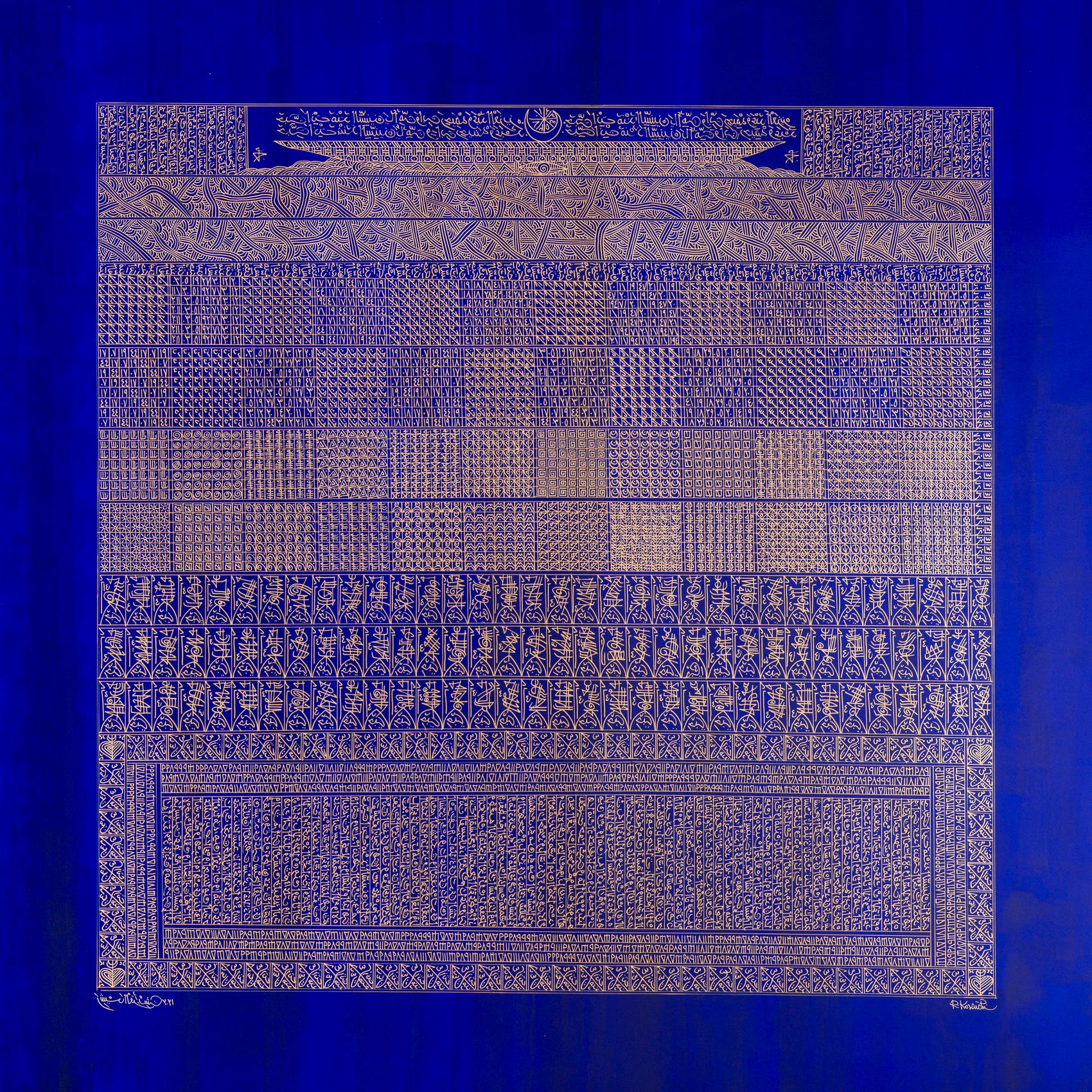
Before I get to the review below (including this gorgeous work by Algerian artist Rachid Koraïchi), I’m sharing some recent standouts that cut across art and tech. (Say it with me! The i•n•t•e•r•s•e•c•t•i•o•n of art and technology!) That means the intersection of art and tech money, too.
1. Outland Art is one of my favorite reads because I always learn something new: most recently a proposed model for revenue-sharing among artists called an “A-Corp,” which makes sense in a world where the market is increasingly comfortable with fractional ownership of an artwork. The idea comes from Yancey Stricker, co-founder of Kickstarter, which lends the idea some weight. If anyone knows how to optimize revenue pooling, it’s that guy.
2. Reed Hastings (the Netflix founder) gave an interview about his vision for a sculpture park on his ski mountain in Utah. Tech money is famously uninterested in art, so this is exciting. Reed, pave the way on this one, please!
3. May I offer you a delightfully offensive experience about AI biases? My friend Tina made whatdoesmyhusbandlooklike.com to see what AI thinks your husband looks like based on, well, what you look like (or wife, or apartment, or job, etc). Asian people, you will get an Asian partner. It’s a few months old, but still funny.
4. Sasha Stiles’ piece A LIVING POEM up at MoMA, which uses AI to write new poetry based on the museum’s collection every hour. What do you think of the work? I like it.
5. And one from the Google Arts & Culture-sphere: Gradient Canopy shares the work of 12 artists using AI to make work about the San Francisco Bay Area’s ecology, including Trevor Paglan, Linda Dounia, and Michael Joo, and includes interviews with the artists about their process.
I was excited to see a Tantra + Sufism exhibition at Aicon Art on Great Jones St (Jan 8-Feb 7). Unfortunately the show did not deliver—at least on the Tantric side of things—but the premise is a strong one: bringing together contemporary and historical artists from both sides of a Hindu-Islam religious divide. This is a chasm that’s widening at a terrifying rate on the subcontinent and at a time when similarities are often swept under the rug, it’s a relief to see these mystical, peaceful, and spiritual branches of each religion united in one place.
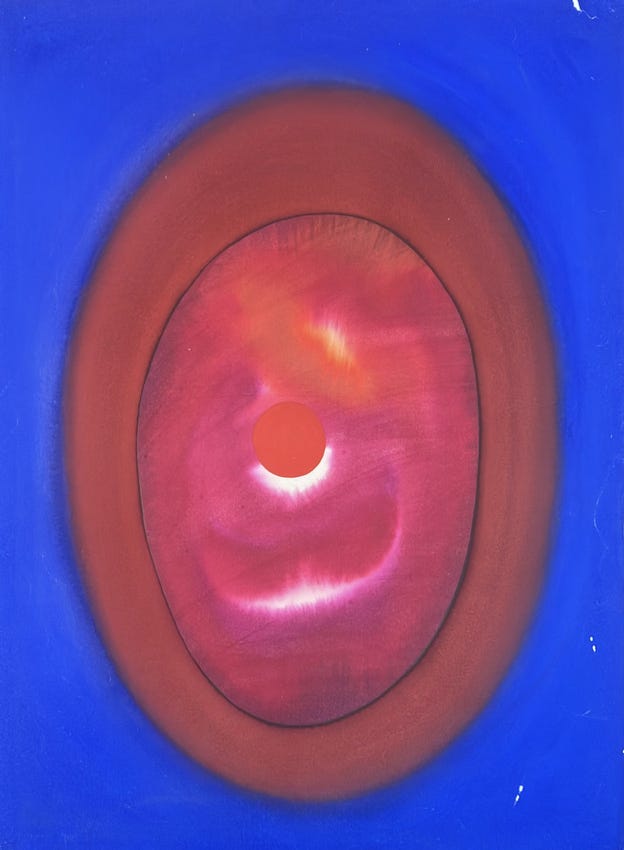
Hindu Tantric paintings are abstract religious artworks meant for private devotion. They are beautiful, non-figurative works stemming from the 19th century that are meant to guide you in metaphysical understanding. Their geometric shapes and delicate colors represent the cosmos, creation and destruction, masculine and feminine energies, and purity. (I’d also argue they were inspirational to Swedish artist Hilma af Klint, who was connected to Indian spiritualism through the Theosophical movement, but that’s another story.) Because they are traditionally hidden from a wider audience they can be difficult to find, so I was excited to see some in person…
Unfortunately many of the Tantric works felt somewhat blunt and clumsy, with only one artist standing out from the four or five shown. GR Santosh’s paintings (1929-1997), far from drawing me in to meditate on the cosmos, repelled me with a grating purple-mustard-teal color scheme that made checking my phone seem suddenly very appealing. Vijay Shinde’s works (b. 1958), too, had jangling colors and muddied surfaces that felt (unintentionally) anxiety-provoking. The best were Prafulla Mohanti’s watercolors (b. 1936), combining the medium’s bleeding edges with sharply delineated color fields to achieve works that felt both rigorous and organic. His overlapping circular shapes represent the Hindu triumvirate of Brahma, Vishnu and Shiva, which are also reflected in his process: as he painted he would chant their names. Something of that egoless devotion has crept into the powerful, pulsing color fields on the walls. In contrast, the surfaces of the Biren De (1926-2011) paintings were distracting, mixing glossy and matte elements that felt like an unsuccessful experiment rather than a finished work. The artist Lancelot Ribeiro (1933-2010), who is supposed to be the star of the show, had mixed success. His orderly, parceled-out compositions and their chaotic curls are fun, all of them rendered in glossy acetate, but they are hard to read as more meaningful than that.
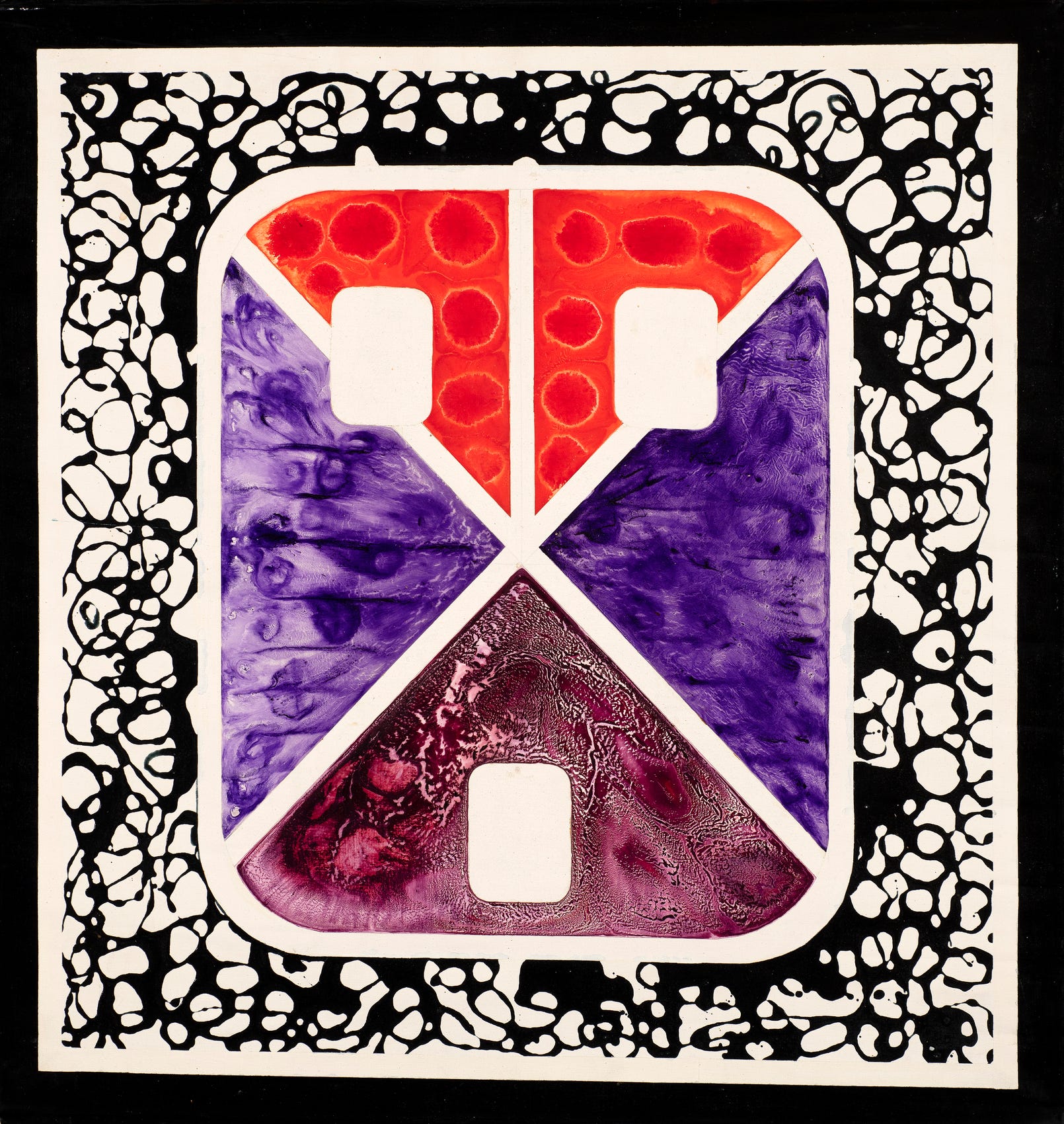
The Sufi artworks, on the other hand, were a delight. If the goal of both genres is to have a go at representing the infinite divine, these artworks have a punchier, more tactile angle while retaining the meditative quality of their Tantric cousins.
A series of works on paper by Sohan Qadri (1932-2011) are best described as sculptures on paper. Carefully excavated grooves and puncture holes mimic natural patterns like beeswax or termite furrows, drawing to mind nature’s orderly destruction. In contrast, works on paper by Safdar Ali Quereshi (b. 1980) echo nature’s renewal. Individual marks cohere into hallucinatory circles that grow and shrink like sardines or starlings swirling together, creating a frenetic, modern interpretation of meditation.


My favorite was a massive, unpainted alabaster wall carving from 2021 by contemporary artist Rachid Koraichi (b. 1947) called Le Chant de l’Ardent Désir VI (the artist is from French-speaking Algeria). It was stunning, somehow bringing to mind orderly Mughal gardens, traditional Indian marble inlay, Arabic script, and the Rosetta stone all at once. His repeating squares and labor-intensive practice of stone carving capture the meditation and discipline of faith and devotion. His blue and gold canvases are equally striking, with hundreds of tidy script-filled rectangles bridging celestial bodies and human writing.
While not all of the works gel, the show is worth seeing, especially if you’re not familiar with Tantric or Sufic art. And if you want to know more about Tantra painting, get this book by French poet Franck André Jamme on his collection of Tantric works.
All images courtesy of the rights holders and Aicon Art
Love this perspecive! That AI bias site is hilarious, curios how it generates those 'husbands'.